Orbital CubeSat Division
Designing and Building a Real Space Mission
The McGill Rocket Team is starting its CubeSat division as a continuation of its Orbital CubeSat R&D project! We're diving into space missions by developing our own nanosatellite and ground station.
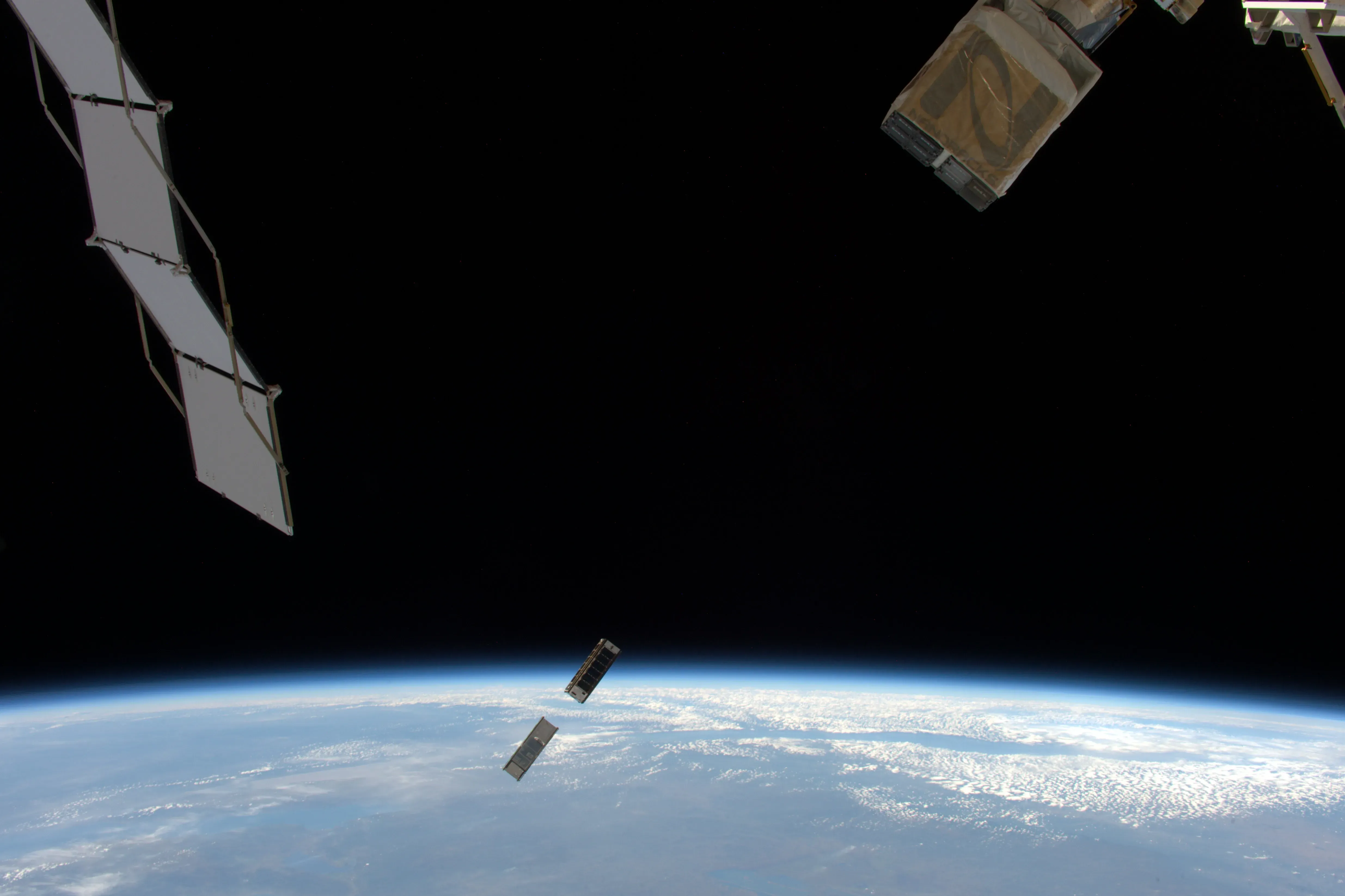
You'll get the chance to work on a real space mission by designing, building, and operating a CubeSat and its ground station. A CubeSat is a nanosatellite with a standardized form factor, creating a lower barrier to entry to space and orbit conditions for scientific investigations.
As this is a long-term mission, your design will only be launched inside a rocket in future years. You will still see your designs in action, as we will use Recovery's High-Altitude Balloon (HAB) project to test designs.
About the Orbital CubeSat Division
Started in 2023, our end goal is to launch a real space mission where we get to design, build, and operate our own CubeSat. This division operates separately from the 6 rocket subteams, with the purpose of developing the expertise of McGill’s student body in space domains while also providing a unique chance to advance space science for driven McGill students and professors. We give students an opportunity to work on exciting aerospace projects and obtain invaluable hands-on experience in engineering and management.
We are aiming to design and build a common CubeSat bus for McGill so that different labs and research groups can use it and adapt it. We are also targeting the next iteration of the CUBICS program offered by the Canadian Space Agency, which provides us with a launch opportunity to orbit Earth.
CubeSat Projects
OCS1 Structures and Mechanisms
The Structures & Mechanisms project is responsible for the physical architecture of the CubeSat, ensuring that the satellite is robust, lightweight, and capable of surviving launch and orbit conditions. This project designs the satellite’s structural frame, component mounting, deployment mechanisms, and other mechanical systems while considering constraints such as vibration, thermal expansion, mass, and manufacturability.
Members will have the opportunity to work with Computer Aided Design (CAD) to model the structure and deployables of the cubesat. They will also get the chance to work with simulations (such as FEAs) to ensure our model is robust enough to be launched in space. Our designs will be validated through physical prototypes and testing of our 3D models through vibration tables and vacuum chambers, ensuring that it can withstand the harsh conditions of space.
This project is perfect for anyone who enjoys hands-on fabrication, and solving physical engineering problems.
OCS2: Command and Data Handling
The Command & Data Handling (C&DH) subsystem is often called the “brain” of the CubeSat, because without a functioning C&DH, the CubeSat would be more similar to headless chicken than to space hardware.
Over the past years, the team has been dedicated to developing C&DH board schematics and memory drivers, establishing communication between processors and supporting the subsystem’s next design phase. This year, we’ll focus on building a reliable architecture, improving how the satellite handles data and commands, and making sure C&DH integrates seamlessly with power, telemetry, ADCS, and payload subsystems.
By joining the OCS Command & Data Handling project, you will have the opportunity to practice embedded programming, work hands-on with memory, processors, microcontrollers, PCB design, communication protocols, and system integration. Members will also gain experience not only in software and hardware, but also in understanding how the whole CubeSat comes together.
OCS3: Space-Ground Communication
The Space-Ground Communication project focuses on one of the most critical aspects of satellite missions: communication. Without a reliable link between the satellite and Earth, a CubeSat becomes little more than space debris. We aim to design and implement a robust communication system that ensures safe, consistent, and reliable data transfer between our CubeSat and its ground station.
To achieve this, the project is divided into multiple components. These include RF circuit design for the onboard radio, antenna development for both the satellite and possibly for the ground station, software-defined radio (SDR), and communication protocols to manage data transfer. Together, these components form the backbone of a functioning satellite mission.
As a team member, you’ll get hands-on experience in one or more subsystems, designing hardware, experimenting with antennas, programming communication protocols, and testing radio modules.
OCS4: Attitude Determination and Control
The Attitude Determination and Control System (ADCS) is a critical system in the CubeSat’s success. It is responsible for maintaining and controlling the CubeSat's orientation in space so that the satellite survives and completes its mission. The ADCS ensures the satellite's sensors, antennas, and solar panels are pointed in the correct direction at the right time. The ADCS achieves this by combining sensors that determine the satellite's orientation (attitude) with actuators that allow the satellite to rotate and make adjustments to correct any deviations.
This year, we aim to develop a working prototype for the ADCS board and create physical tests to gauge the performance of the system. Recruits will design control circuits for actuators and circuits to read and control sensors, and develop PCBs. As well as program a microcontroller and develop drivers to read sensor data, sensor fusion algorithms, and control algorithms for actuators. This will involve developing a controller on MATLAB/Simulink and conducting hardware-in-the-loop testing to refine the algorithm. Lastly, on the mechanical and physics side, recruits will develop and manufacture magnetorquers for precise actuation, analyze complex torque equations for the development of sensor fusion and control algorithms, and model physical perturbations in space to refine the accuracy of the controller on MATLAB/Simulink.
The ADCS project is highly collaborative between disciplines, and one of the most complex systems on the CubeSat. By joining the team, you will gain industry-applicable skills in the fields of controls, PCB development, embedded systems, and gain a better knowledge base on satellite development.
OCS5: Power
The Power project is responsible for generating, storing, and distributing electrical power to all subsystems of the CubeSat. As the most critical enabler of satellite functionality, the power system is also the most heavily scrutinized, verified, and tested to ensure it is safe to fly aboard a rocket and remain reliable in orbit for 3 to 12 months.
You will gain hands-on experience with CubeSat power systems as a starting point, adapting it to our mission requirements and improving it where needed. Core responsibilities include selecting and designing solar panels and batteries, developing power distribution boards, and implementing battery charging and protection systems. You will also investigate redundancy and fault-tolerant designs to ensure the CubeSat remains operational even under unexpected conditions.
This is a highly R&D-focused project, emphasizing careful iteration, testing, and validation. You will work through the full hardware development cycle: circuit design and simulation, PCB layout, prototyping, and rigorous verification. The work will challenge you to optimize energy generation, storage, and distribution within the strict limits of mass, volume, and orbital conditions, while ensuring robustness and reliability.
OCS6: High-Altitude Balloon (HAB)
The High Altitude Balloon (HAB) project is an exciting initiative at MRT. The HAB is crucial in our development, it allows us to test our design in a space like environment These balloons typically float to an altitude ranging from 10km to 30km. The stratosphere allows us to validate the integrity of our cubesat or expose major flaws in our design. Two HABs were launched in the last design cycle, helping us to accumulate valuable data and experience and improve the quality and efficiency of our design and launch processes. The recovered data included information on atmospheric pressure, temperature, GNSS log and descent rates, as well as visual observations of component performance, all of which are essential for validating our research.
By joining the HAB project, you'll have the opportunity to design, build and launch high-altitude balloons. You will participate in every stage of the project, from the initial design to the final launch and recovery. Whether you're interested in structural design or electronics, there's something for everyone in this project. It's a great opportunity for experienced individuals to apply their knowledge, and also perfect for ambitious newcomers who want to learn about different subsystems along the way.
Join the HAB team as part of a multidisciplinary project that pushes the boundaries of innovation!